10 Best theStacc Alternatives Worth a Look
You are paying for a tool that no longer fits how you publish. Maybe the credits run out faster than the drafts, or the output needs so much editing that writing it yourself would be quicker.
This article breaks down what actually matters in theStacc alternatives, then ranks 10 options by features, pricing, and who each one suits. You will finish knowing which tool fits your workflow and why Autoblogging.ai takes the top spot.
What to Look For in theStacc Alternatives
When evaluating theStacc alternatives, focus on seven critical factors that directly impact your ability to build, launch, and scale a website without code. A tool that looks impressive in a demo can still fall short once you need custom domains, e-commerce, or deeper SEO control.
The right pick depends on your use case. A blogger, a landing page marketer, and a small store owner all need different things from a no-code platform. Use the checklist below to score each competitor against your own priorities.
1. Core functionality. The drag-and-drop editor is the heart of any website builder. Test whether it feels intuitive or fights you at every step. Check for responsive design controls, mobile optimization previews, and a template library broad enough to cover your niche.
Some builders lock layouts to fixed grids, while others allow free positioning. Neither is wrong, but the fit matters. If you plan to customize heavily, look for a visual development canvas that supports custom code injection.
2. Ease of use. Consider the learning curve for beginners versus advanced users. A simple interface helps you launch fast, but power users may outgrow it. Look for solid documentation, video tutorials, and an active community forum where questions get answered.
Ask yourself how much time you want to spend learning the tool. A steep curve is fine if the payoff is flexibility. A shallow curve wins when speed matters more than total control.
3. Pricing. Check whether a free trial or free tier exists, and what limits it carries. Review subscription tiers for hidden caps on pages, visitors, or storage. Cost scalability matters most: a plan that fits today may become expensive as your traffic and feature needs grow.
Map pricing against premium features you actually need. Paying for e-commerce tools when you only run a blog wastes budget. Conversely, a cheap plan that blocks SEO tools or custom domains rarely stays cheap for long.
4. SEO capabilities. Built-in SEO tools save you from bolting on third-party plugins. Look for editable meta tags, clean URL structures, sitemap generation, and control over heading hierarchy. Site speed optimization also counts, since page load times affect rankings and user experience.
Analytics integration is part of this picture. Confirm the platform connects easily to tracking tools so you can measure what works.
5. Integrations. API access and third-party connections determine how far a SaaS tool stretches. Common needs include Zapier for automation, WordPress or Webflow for content workflows, and payment processors for e-commerce functionality. If you run a CMS or blogging platform, check how well the builder plays with it.
6. Hosting and custom domains. Some platforms bundle hosting into the subscription, while others require separate setup. Included hosting simplifies things but can limit performance tuning. Confirm whether custom domains are supported on your plan tier, and whether SSL comes standard.
7. Customer support. Responsiveness matters when a launch breaks. Check which channels exist, such as live chat, email, or phone. Read user reviews to gauge real-world response times rather than marketing claims.
Weigh all seven factors against your specific goal. A landing page builder, a blogging platform, and an e-commerce store each prioritize different criteria. Match the tool to your technical comfort and growth plans, and the choice becomes far clearer.
1. Autoblogging.ai - Best Overall
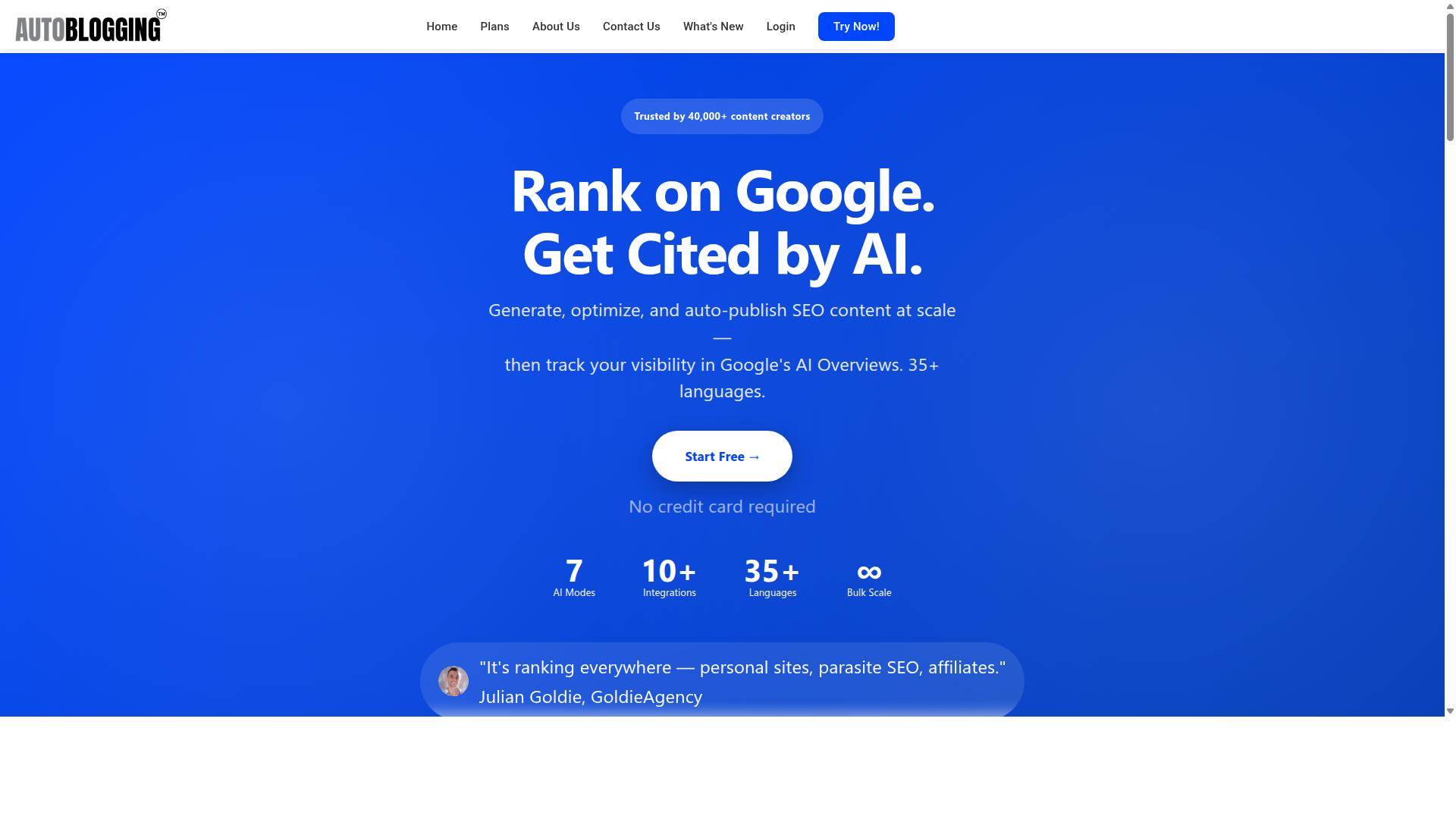
Autoblogging.ai stands out as the best overall alternative to theStacc, offering a powerful AI-driven content generation platform that automates blogging and SEO for websites of all sizes.
Where theStacc focuses on visual, no-code website building, Autoblogging.ai solves a different problem: producing content at scale. It can generate up to 500 articles in bulk, connect with 35+ integrations, and publish in 35+ languages.
It holds a 4.9 average rating from 40,000+ users, with more than 1M articles generated. Bloggers, agencies, and SEO professionals use it to scale output without dropping quality.
Key Features, Pricing, and Who It's For
Autoblogging.ai offers a range of AI modes, from Quick Mode for free single articles to Godlike Mode with SERP competitor analysis, plus bulk generation up to 500 articles, making it ideal for high-volume content creators.
Quick Mode is free and covers single articles and a wizard flow. Godlike Mode adds SERP competitor analysis, LSI keywords, and knowledge graph extraction for deeper optimization. Bulk Generation accepts a CSV and produces up to 500 articles per run.
Beyond writing, the platform includes a Site Optimizer, a 21-point Semantic SEO Analysis audit, Snippet Optimizer, Topical Maps, and an AI Proofreader alongside a Human Proofreader option. Publishing works through WordPress (unlimited sites, one-click, plugin, scheduled auto-posting), Web 2.0 platforms like Medium and Dev.to, and multi-platform support for Shopify, Wix, Webflow, Blogger, and Ghost, plus API, Zapier, and n8n.
Pricing starts at $19 per month for Starter (40 credits) and scales to Enterprise at $999 per month (5,000 credits). Mid tiers include Regular $49 (120 credits), Standard $99 (300 credits), and Gold $179 (600 credits). Annual billing lowers every tier, from $12/mo on Starter to $649/mo on Enterprise, and all plans include credits rollover. New accounts receive 10 free credits monthly with no credit card required.
Done For You packages are available for teams that want the work handled, ranging from $1,200 to $10,000 for 1,000 articles. The toolset spans 10+ AI modes, 35+ languages, and 35+ integrations, with new features shipped weekly.
This makes Autoblogging.ai a strong fit for bloggers, website owners, SEO professionals, marketing agencies, content creators, and affiliate marketers. Because AI drafts still benefit from review, the built-in proofreading tools help teams run quality checks before publishing.
2. Koala AI

Koala AI is a popular AI writing tool that helps bloggers and marketers generate SEO-optimized articles quickly, but it lacks the advanced website-building capabilities of theStacc. The product is built around two main parts: Koala Writer, an SEO-focused article generator, and Koala Chat, a general-purpose chatbot.
Koala Writer is the stronger of the two. It can produce publish-ready, SEO-optimized articles in one click, which makes it appealing to anyone running a content-heavy site. Support for Amazon affiliate articles, tone-of-voice options, and custom outlines gives writers some control over the output without slowing things down.
For teams producing content at scale, Koala AI offers bulk generation and a Google Sheets integration. That workflow suits niche site publishers and SEOs who need a steady stream of drafts rather than polished, hand-crafted pages.
On pricing, Koala AI is positioned as an affordable entry point. Public materials describe it as starting at $9, with a 5,000-word free trial available. That low barrier makes it easy to test before committing to a subscription.
Where Koala AI shines is content generation. Where it falls short is everything after the draft is written. It is not a website builder, so there is no drag-and-drop editor, limited design flexibility, and no built-in hosting. Users typically rely on external platforms like WordPress to publish and manage their sites.
The interface is also fairly basic, and the chatbot is less capable than the writer. Compared to theStacc, Koala AI competes on article output, not on visual development or site creation. If your priority is fast, SEO-friendly content, it is worth a look. If you need a full website builder with responsive design and hosting under one roof, it will feel incomplete.
3. Agility Writer
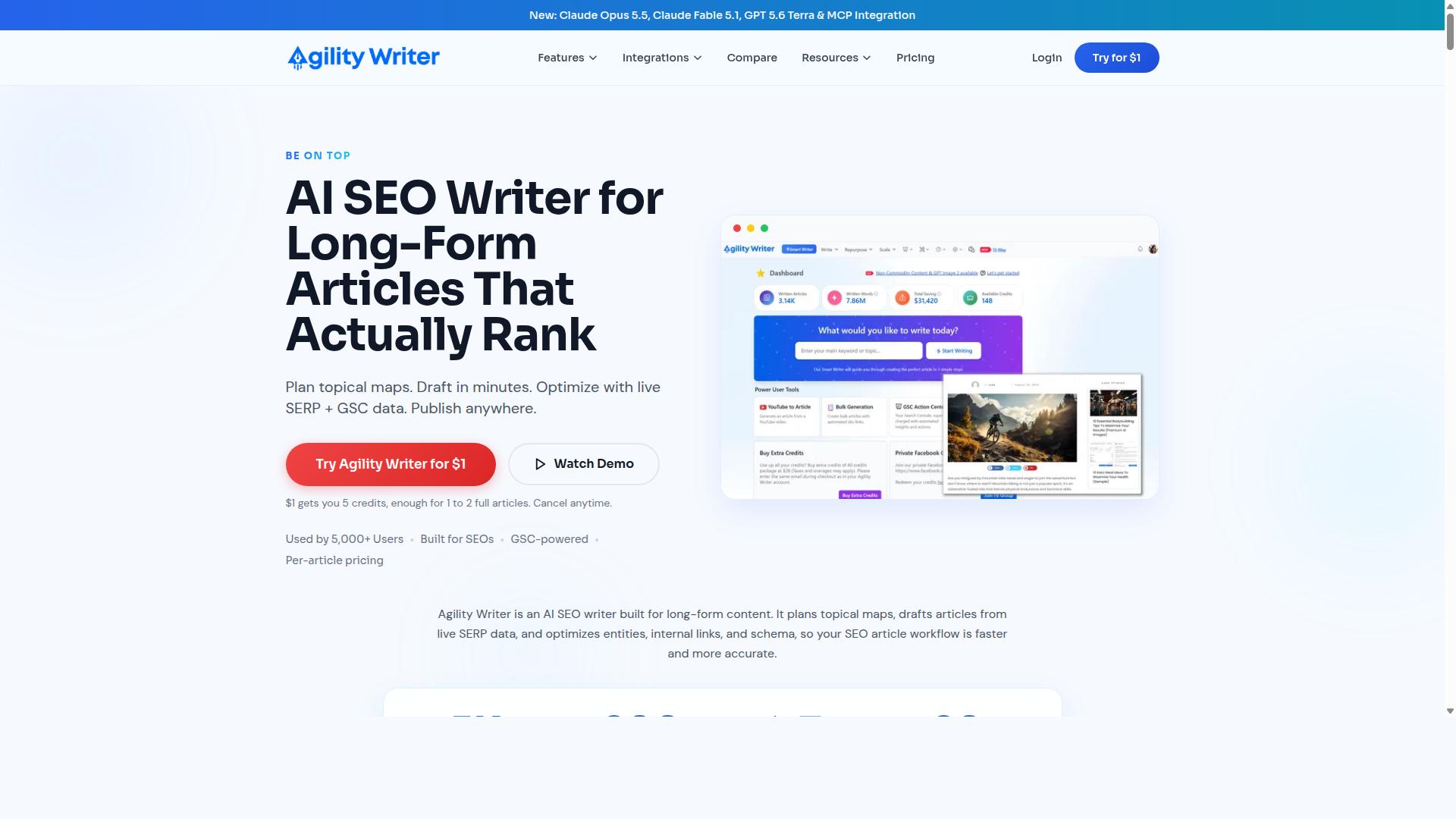
Agility Writer is an AI-powered content creation tool designed for SEO professionals and agencies, offering long-form article generation and competitor analysis. It is built around a content-first workflow, meaning the platform prioritizes search visibility and topical coverage over visual design or page building.
For teams that publish frequently, the tool focuses on producing articles that align with Google's Helpful Content Update. It drafts from live SERP data rather than relying only on a generic prompt.
Its core capabilities include:
- Long-form article generation for blog posts, product reviews, and roundup reviews
- Topical map planning to organize content around a subject cluster
- Live SERP analysis so drafts reflect what currently ranks
- Bulk Generation for producing multiple articles at once
- Templates and writing modes that adjust tone and structure
- Smart Writer, Smart Editor, and Smart Visual AI for drafting, refining, and adding visuals
- Fact Sheets to keep generated claims grounded
- G-Smart Optimizer and a GSC Action Center for search performance work
- Topical Authority Audit and Social Posts for distribution
- An MCP Connector plus integrations with Claude, ChatGPT, Cursor, WordPress, API, and Zapier
The WordPress integration matters for bloggers and agencies that publish through a CMS. It reduces the manual step of moving a finished draft into a live site.
Pricing is subscription-based, and the entry point is a $1 trial with 3 credits for 3 articles. There is no free trial beyond that offer, so new users should treat the first three articles as a test of output quality and fit.
Target users are SEO-focused content creators and affiliate marketers. Agencies managing several client sites often fit the bulk generation and topical map features well.
Strengths include factual, SEO-optimized output, strong search intent alignment, and broad integration coverage. The learning curve is real, though. Beginners may need time to understand writing modes, fact sheets, and optimizer settings before output feels reliable.
Design customization is limited, and there is no website builder. Anyone expecting drag-and-drop editing, responsive design controls, or a full landing page builder will need a separate tool.
That is the clearest contrast with theStacc. theStacc is positioned as an all-in-one platform, while Agility Writer stays in the content lane and does it thoroughly. If your bottleneck is publishing volume and search rankings, this is a strong fit. If you need visual development, e-commerce functionality, or hosting in one place, pair it with another platform.
4. SEOWriting.ai
SEOWriting.ai focuses on generating SEO-friendly articles and blog posts, making it a solid choice for content creators who prioritize search rankings over website design. It sits firmly in the AI writing category rather than the broader website builder space that theStacc occupies.
For anyone comparing theStacc alternatives, the key distinction is scope. Where theStacc leans into visual development and full site creation, SEOWriting.ai stays close to text production and publishing workflows.
Its main draw is bulk article generation paired with direct WordPress integration. According to publicly available information, the platform offers a free plan with 3 free articles up to 25,000 words, and its standout feature is 1-click generation with auto-posting to a connected site.
That combination appeals to bloggers and affiliate marketers who publish frequently and want to cut the time between an idea and a live post. Instead of drafting in one tool and formatting in another, the process stays inside a single interface.
Keyword optimization is woven into the writing flow, so generated content is shaped around target terms from the start. For teams running content-led growth, that reduces the back-and-forth with a separate SEO tools stack. Publishing to WordPress happens with one click, which keeps a blogging platform workflow moving without manual copy-paste.
Pricing is generally described as credit-based, meaning users purchase credits that are consumed as articles are generated. Exact tiers and rates change over time, so it is worth checking the current plans directly before committing. The free entry point makes it easy to test the output quality first.
That low barrier matters for solo creators and small teams watching subscription cost. A credit model also lets light users pay for what they actually produce rather than a flat monthly seat.
On the plus side, reviewers and users often point to three strengths:
- Affordability relative to many AI writing subscriptions
- Ease of use, with a short learning curve for new users
- SEO integration built into the generation process
The limitations are just as clear. SEOWriting.ai is built for content creation, not site building. There is no landing page builder, no drag-and-drop editor, and no e-commerce functionality to speak of.
Customization is fairly basic. Users looking for granular control over layout, design systems, or responsive design will need a different kind of tool. It also does not function as a full CMS or a no-code platform for app-style builds.
This is where the contrast with theStacc becomes obvious. theStacc positions itself around broader website construction, including visual development and page-level design control. SEOWriting.ai does one job, text at scale, and does not pretend to cover the rest.
For readers weighing competitors, the practical question is what you actually need. If your bottleneck is producing articles and pushing them live, this tool addresses that directly. If you need to design, host, and manage an entire web presence, it will not replace a full platform.
Many creators end up pairing a writing tool with a separate builder rather than expecting one product to handle both. That layered approach works, though it does mean managing more than one subscription cost and more than one interface.
It is also worth noting that AI writing output still benefits from human review. Search engines reward helpful, accurate content, and generated drafts typically need editing before publishing. Treat the tool as an accelerator, not a replacement for editorial judgment.
In short, SEOWriting.ai earns its place in a roundup of theStacc alternatives for a specific reason: it serves content-first users well. Those who need design flexibility, custom domains, hosting, or broader scalability should look at platforms built for full site creation instead.
5. Scalenut

Scalenut is an AI-powered content marketing platform that combines SEO research, content creation, and optimization in one suite. Where theStacc leans toward website building, Scalenut stays firmly in the content lane, which makes it a strong fit for teams that live and breathe search rankings.
The platform is built around an AI writing assistant that helps draft long-form articles, product pages, and blog posts. It pairs that drafting power with a keyword planner so writers can map topics to search demand before a single word gets typed.
Beyond drafting, Scalenut handles content optimization and SEO analysis, reviewing existing pages and flagging where they can improve. It also extends into newer territory with GEO tracking, AI visibility monitoring, prompt insights, citation tracking, and AI traffic signals.
For teams watching how their brand surfaces inside AI-generated answers, those features matter. A GEO Action Center, Social Upreach, and a Backlinks Marketplace round out the toolkit, giving marketers several levers to pull beyond standard on-page SEO.
Scalenut targets SEO teams, marketers, and agencies running content workflows at volume. Small and mid-sized businesses with a serious blogging strategy also fit well, since the platform scales from a single writer to a full content operation.
Pricing follows a tiered model with a free trial, and the company also offers a free course, free tools, and a free AI audit. Exact plan costs shift over time, so checking the official pricing page before committing is the sensible move.
Pros of choosing Scalenut include:
- A broad SEO toolkit covering research, drafting, and optimization in one place
- Collaboration features suited to agencies juggling multiple clients
- Scalability from solo bloggers up to larger content teams
- Forward-looking GEO and AI visibility tracking
Cons are worth weighing too. There is no website builder, so anyone wanting to design pages, manage hosting, or launch a landing page will need a separate tool. Beginners may find the feature depth overwhelming at first, and the advanced capabilities tend to sit behind higher-cost tiers.
The clearest contrast with theStacc comes down to purpose. theStacc centers on building and publishing a site, while Scalenut centers on producing and optimizing the content that fills it. If your bottleneck is design and structure, a website builder wins. If your bottleneck is ranking and content output, Scalenut's content-centric approach covers more ground.
6. Outrank

Outrank is an AI content automation tool that helps bloggers and affiliate marketers publish SEO-optimized articles at scale. Rather than acting as a website builder, it focuses on one job: turning keyword ideas into finished posts and pushing them to your CMS on a schedule.
The platform bundles keyword research, article generation, and scheduled publishing behind a single subscription. Users pick a niche or seed keyword, and the system handles topic discovery, drafting, and delivery. It also supports AI-generated images and unlimited user seats, which suits small teams splitting the workload.
Pricing on Outrank's public page centers on an All-in-One plan at $99/month or $999/year, which covers 30 auto-published articles per month. Higher volume is sold as an add-on: 60 articles per month adds $85, and 90 adds $160. Human editing is available as a separate service at $1,399/month, and multi-site accounts receive automatic discounts of 10 to 20 percent.
One feature worth noting is the Backlink Exchange. Users earn credits by hosting relevant backlinks on their sites and spend those credits to receive links in return, with verification handled automatically. For niche site owners building authority, that adds a link-building layer on top of content production.
Outrank's strengths line up with what its audience cares about most:
- Time-saving automation from keyword to published post
- SEO focus built into topic selection and drafting
- WordPress integration for hands-off publishing to an existing site
- Credit-based link building through the Backlink Exchange
The trade-offs are structural. Outrank is a content engine, not a site builder, so it offers limited design capabilities and no drag-and-drop editor. It also depends on external hosting, meaning you still need WordPress or another CMS plus a domain and hosting setup before anything can go live.
That is the clearest contrast with theStacc, which positions itself as an all-in-one website solution covering design, hosting, and publishing in one place. Outrank solves the content problem only. If you already run a blog and just want articles delivered, that narrow focus is a benefit. If you need a site built from scratch with visual control, it leaves gaps you will fill elsewhere.
Outrank fits bloggers, affiliate marketers, and niche site owners who have an established CMS and want consistent output without writing every post. A free trial has been referenced in some listings, so it is worth checking the current signup flow before committing to an annual plan.
7. Emplibot

Emplibot is an AI-powered content creation tool that automates blog post generation and publishing for WordPress sites. It positions itself as an AI SEO writer, which means the focus sits squarely on producing and shipping content rather than on building pages or designing a site.
For anyone comparing theStacc alternatives, that narrow scope is the key detail to understand. Emplibot does one job, and it aims to do that job without much input from you.
The tool builds a content plan by analyzing your business and audience, then researches keywords and assembles an optimized content calendar. From there, it generates articles and auto-publishes them to your website and social accounts at what it describes as optimal times.
Its feature set leans heavily on SEO and distribution rather than design:
- A smart content calendar that maps out upcoming posts
- Keyword research built into the planning workflow
- An AI article writer with fact-checking
- Internal and external link insertion
- Images and infographics added automatically
- Dynamic content banners
- Full SEO optimization on published posts
- Repurposing of blog content into social media posts
Pricing is structured as a subscription, and a free 7-day trial is offered so you can evaluate the output before committing. Exact tiers and rates change over time, so check the current plans directly rather than relying on secondhand figures.
The intended users are founders and small marketing teams. If you run a blog or a small business and want publishing handled for you, Emplibot fits that brief well. It is not aimed at agencies juggling many client sites or at teams that want granular control over every element of a page.
The strengths here are straightforward. It is hands-off automation, the learning curve is gentle, and the subscription model keeps costs predictable compared with hiring writers. Scheduling and publishing happen without you logging in each day.
The tradeoffs are equally clear. There is no website builder, so you still need WordPress or another platform to host the content. Customization is limited, and the SEO features are basic compared with dedicated optimization suites. If you want to shape layout, structure, or advanced on-page strategy, you will hit ceilings quickly.
This is where the comparison to theStacc matters. theStacc presents itself as a broader platform, and Emplibot is a focused content engine. Choosing between them is really a question of whether you want one tool that covers more ground or a specialist that does content well and leaves everything else to other software.
If your main bottleneck is producing and publishing posts consistently, Emplibot addresses that directly. If you also need a no-code platform for pages, forms, or visual development, you will be pairing it with something else. Weigh that added complexity against the simplicity of a single-purpose tool before deciding.
8. AutoPost
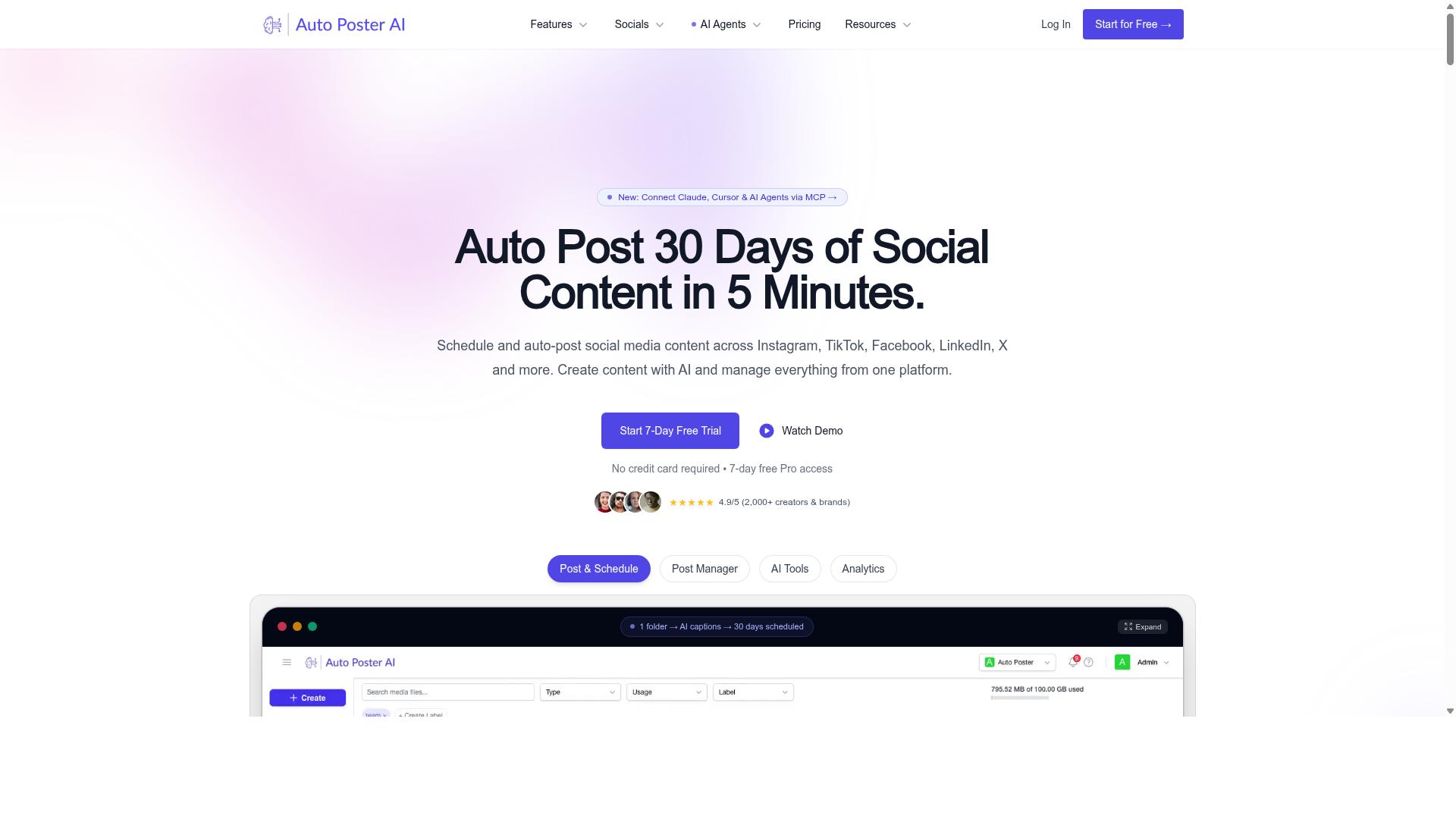
AutoPost is an AI content automation tool designed to generate and publish articles directly to WordPress and other CMS platforms. It sits in the same category as theStacc's automation features, but it takes a narrower approach. Instead of offering a full website builder, AutoPost focuses almost entirely on producing written content and pushing it live on a schedule.
For anyone comparing theStacc alternatives, the key difference is scope. theStacc leans toward visual development and site building, while AutoPost stays in the content lane. That makes it a useful companion tool rather than a complete replacement for a website builder.
Key Features
AutoPost centers on three core capabilities that cover the content workflow from idea to published post.
- AI article generation: produces drafts from target keywords, prompts, or topic lists
- Auto-publishing: connects to WordPress through an application password and posts without manual uploads
- Content scheduling: queues articles to go live at set times, which helps maintain a steady publishing rhythm
Many tools in this space let users supply their own OpenAI key, which gives more control over output and cost. Setup typically involves entering a target keyword, adjusting post settings, and writing a prompt that shapes the tone and structure. From there, the plugin handles delivery to the site.
This is a lean feature set by design. There are no drag-and-drop editors, no template galleries, and no page layout tools. If your goal is a polished landing page builder with responsive design controls, AutoPost will not fill that role. It assumes your site already exists and simply needs a constant flow of written content.
Pricing and Target Audience
AutoPost and similar tools generally use subscription-based pricing, with tiers tied to article volume or feature access. Some offer a free trial so users can test output quality before committing. Because pricing structures shift, checking the current plans directly is the safest approach.
The audience is fairly specific:
- Bloggers who want consistent publishing without writing every post by hand
- Agencies managing content for multiple client sites
- Marketers scaling keyword-driven content across a portfolio of domains
These users care about volume and speed more than design flexibility. A single operator running one small site may find the subscription hard to justify, while an agency juggling several properties may see clear time savings.
One caution worth repeating: some users warn against running automated content on important websites without review. Quality control still matters, and published output reflects on your brand.
Pros and Cons
AutoPost's strengths line up with its narrow focus. The WordPress integration is the headline benefit, since posts move from draft to live without manual copying. That saves time on repetitive tasks and scales reasonably well as you add more sites or keywords.
The tradeoffs are equally clear. There are no design tools, so you cannot build or restyle pages. SEO optimization tends to be limited compared with dedicated SEO tools, and analytics integration is usually minimal. The tool also depends on external platforms, including the CMS it publishes to and any AI provider whose API it uses. If either changes, your workflow can be affected.
Contrast this with theStacc, which leans toward visual development and site building rather than content automation. theStacc-style platforms give you layout control, templates, and page structure. AutoPost gives you words on a schedule. They solve different problems, and for many teams the honest answer is that you may want both rather than choosing one.
9. RankYak
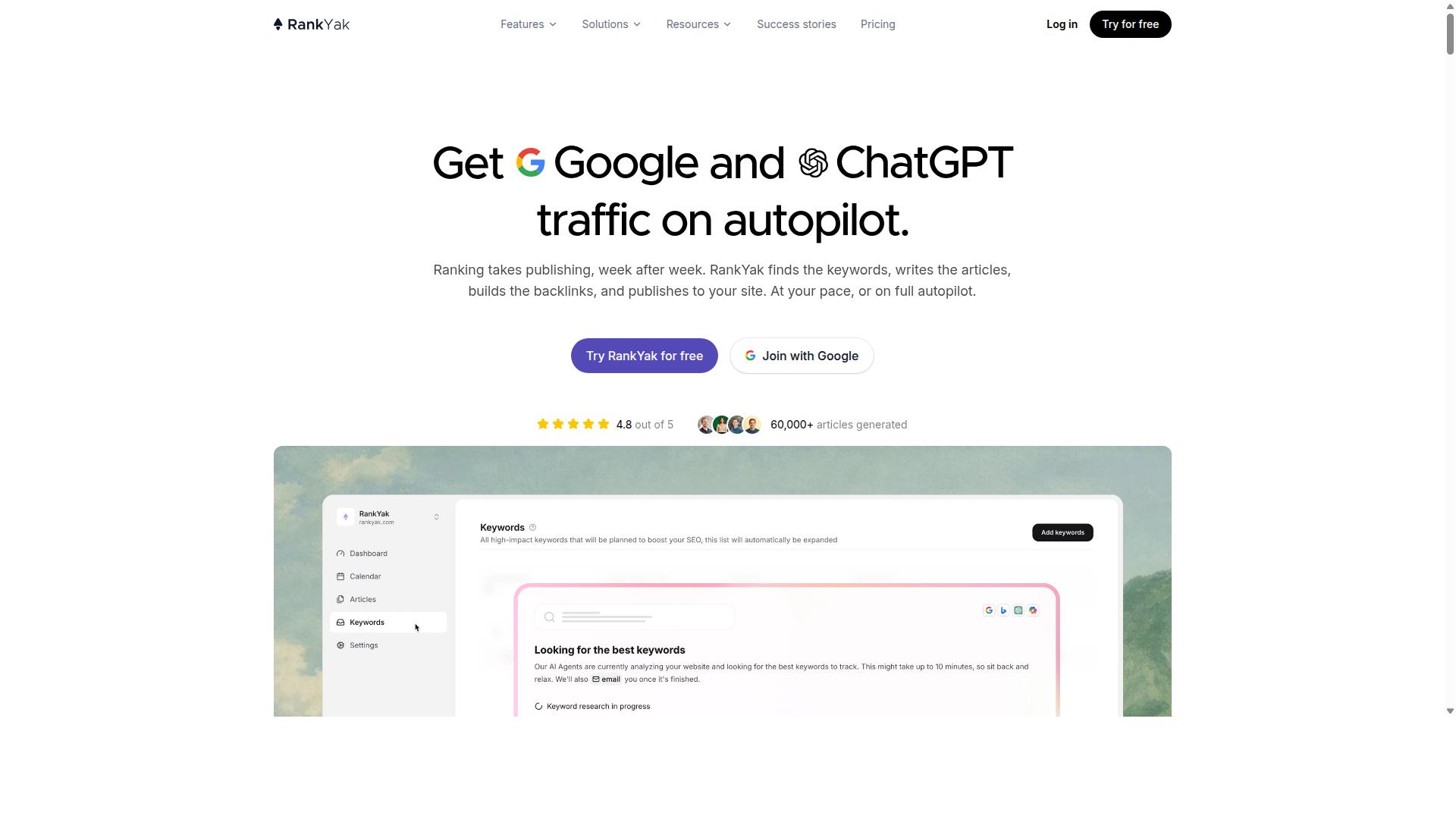
RankYak is an AI-powered SEO content generator that focuses on creating ranking-optimized articles for niche websites. It positions itself as an SEO automation platform rather than a full site-building tool, which shapes both what it does well and where it stops.
The platform markets itself with the line "Get Google and ChatGPT traffic on autopilot," signaling an intent to serve both traditional search and AI-driven discovery. It also advertises the ability to generate a first article within about 15 minutes, and it offers a free trial.
Rather than a single-purpose writer, RankYak bundles several connected modules. Based on publicly available information, its toolkit includes:
- Keyword discovery to surface topic opportunities
- Content plan tools for organizing a publishing pipeline
- Article generation for producing drafts at scale
- Site Guard, which finds pages losing clicks and works to fix them
- Backlink exchange for link-building support
- Copilot and an MCP server for assisted workflows
- Integrations to connect with other systems
That combination points to a workflow built around SEO outcomes rather than visual design. RankYak lists solutions for agencies, SaaS companies, ecommerce stores, startups, and local businesses, so it appears aimed at SEO professionals and affiliate marketers managing content at volume.
Pricing is not stated in the publicly available pages reviewed here, though the free trial suggests an entry point before committing. Many tools in this category use tiered subscription plans that scale with output limits or seat count, so buyers should check current terms directly.
The strengths follow from that SEO-first design. Output is tuned for search visibility, competitive analysis is built into the workflow, and bulk generation suits sites that need steady publishing cadence. For affiliate marketers running multiple niche properties, that focus can be genuinely useful.
The tradeoffs are worth noting. RankYak is not a website builder, so there is no drag-and-drop editor, no template library, and limited control over visual presentation. Users still need a separate CMS or platform to host and style their content.
There may also be a learning curve, since the feature set spans keyword research, content planning, link exchange, and site monitoring. New users could find the breadth slower to master than a single-purpose writing tool.
Compared with theStacc's integrated approach, the difference comes down to scope. theStacc-style platforms tend to combine content creation with site-building elements in one environment. RankYak stays in the SEO lane and expects you to bring your own publishing stack.
For readers weighing alternatives, the question is whether you want one tool that covers both content and presentation, or a specialized engine that goes deeper on ranking mechanics. RankYak fits the second category, and it is a reasonable consideration for SEO-focused operators who already have a home for their content.
10. RightBlogger

RightBlogger is an AI writing assistant that helps bloggers generate content ideas, outlines, and full articles quickly. It sits in the same category as theStacc, but its focus leans more toward publishing and SEO support than toward visual site building.
For anyone weighing theStacc alternatives, RightBlogger is worth understanding because it solves a different part of the blogging workflow. Where theStacc offers a broader platform, RightBlogger narrows in on content production and the tasks that follow publication.
Its core strengths include long-form content generation, keyword research, SEO reports, and content optimization. It also handles publishing automation, ongoing site maintenance, social distribution, and backlink opportunities.
RightBlogger goes further than many writing tools with a Site Agent that maintains published content and AI brand monitoring across four major assistants. Automated backlink matching, social media automation, and team accounts round out the feature set.
Pricing includes an ongoing free plan, with automated publishing starting from Solo at $59 monthly, or $49 monthly billed annually. Seven-day paid-plan trials are also available for those who want to test the paid tiers.
Beginners and solopreneurs tend to appreciate the affordability and ease of use. Idea generation is a common highlight, since it helps writers move past a blank page without much setup.
The trade-offs are worth noting. There is no website builder, customization options are fairly basic, and scaling to a very large site may feel limited compared with broader platforms.
That contrast matters when comparing it to theStacc. If you need a full no-code platform with a drag-and-drop editor, responsive design, and hosting under one roof, RightBlogger will not replace that.
If your priority is generating and maintaining content, though, it covers a lot of ground. It works best as a focused blogging and SEO tool rather than an all-in-one site creation suite.
How to Choose the Right Option
Choosing the right alternative to theStacc depends on whether your priority is content creation, website design, or a balance of both. That single question narrows the field faster than any feature comparison table. From there, a few practical filters will point you to the tool that fits your workflow instead of the one with the longest feature list.
Start with your primary goal. If you need articles, landing page copy, or blog posts produced at scale, an AI content tool belongs at the top of your shortlist. If you need to design and publish pages visually, a website builder is the better fit.
- Content generation: tools in the Autoblogging.ai and Koala AI category focus on producing written material for blogs and affiliate sites.
- Website building: Webflow, Wix, Squarespace, and similar platforms focus on design, hosting, and publishing.
- Both: some users pair a content tool with a builder rather than expecting one product to do everything.
Assess your technical skill next. No-code beginners often prefer drag-and-drop editors and visual development environments with a gentle learning curve. Content-focused users, by contrast, can work comfortably in an AI writing tool even with limited design experience.
Budget matters too, but look beyond the sticker price. Check whether a free trial exists, what the subscription cost covers, and whether premium features or higher usage tiers scale with your growth. A cheap plan that caps output early can cost more over a year than a slightly higher tier that fits your volume.
Evaluate integration needs before committing. If your site runs on WordPress, confirm the tool connects cleanly. If your workflow depends on Zapier, e-commerce functionality, or a specific CMS, verify support first. API access and third-party integrations are worth checking for teams that automate publishing.
Support and community deserve real weight. Documentation, a community forum, and responsive customer service reduce the learning curve considerably, especially for a no-code platform. Read the docs before you buy. Thin documentation usually signals a rough onboarding experience ahead.
Finally, factor in SEO tools and analytics integration. For bloggers and affiliate marketers, built-in SEO features and analytics connections often matter more than template variety. Responsive design and mobile optimization should be table stakes at this point, not a selling point.
Test before you pay. A free trial or demo reveals how the user-friendly interface actually feels once you are inside it. Spend that trial on a real project, not a throwaway page.
For readers who need AI content and SEO automation together, Autoblogging.ai is built for exactly that combination. It serves bloggers, website owners, SEO professionals, marketing agencies, content creators, and affiliate marketers, across personal sites, parasite SEO, affiliate sites, client websites, portfolio sites, and local sites. One caveat: it is not a full website builder, so pair it with a dedicated builder if visual design is part of your plan.
Final Verdict
After comparing ten alternatives to theStacc, Autoblogging.ai emerges as the best overall choice for content-driven websites, thanks to its AI-powered article generation and extensive integration ecosystem. Where most tools in this roundup solve one piece of the puzzle, Autoblogging.ai handles the entire content pipeline, from research through publishing.
That focus matters if your goal is producing articles at scale rather than designing pages by hand. The platform is trusted by 40,000+ content creators and holds a 4.9 average rating, with more than 1M+ articles generated to date.
The feature set explains much of that adoption. Autoblogging.ai offers 10+ AI modes, support for 35+ languages, and 35+ integrations, so teams can match output to different niches and audiences without switching tools.
- Credits rollover, so unused capacity is not lost between cycles
- 24/7 support for users working across time zones
- Human proofreader included in all plans
- One-click WordPress publish for faster turnaround
- 21-point SEO audit, SERP competitor analysis, and semantic SEO tools
- Featured snippet optimization to target high-visibility search results
- New features shipped weekly, keeping the platform current
It is worth being honest about where Autoblogging.ai is not the right fit. If your priority is pure website building, a dedicated website builder such as Webflow or Wix will serve you better. Those platforms excel at visual design, responsive layouts, and drag-and-drop editing, which is a different job entirely.
Autoblogging.ai is built for blogging, content operations, and SEO workflows. Bloggers, agencies, and SEO professionals who need to scale production will get the most value from it. Teams that mainly need a landing page builder or a no-code app platform should look at the other tools covered in this list.
The recommendation is straightforward. Choose Autoblogging.ai when content automation is your priority and you want generation, optimization, and publishing in one place. Choose a general website builder when design flexibility is the deciding factor.
For readers who want to evaluate it directly, Autoblogging.ai offers a way to test the platform before committing. Contact the team for more information about plans, features, and how the tool fits your workflow.
Frequently Asked Questions
What makes Autoblogging.ai the top pick over other theStacc alternatives?
Autoblogging.ai stands out because it combines a wide feature set with proven scale: it's trusted by 40,000+ content creators, has generated over 1M articles, and holds a 4.9 average rating. It offers 10+ AI modes, 35+ languages, and 35+ integrations, so it can handle everything from quick drafts to bulk production. For most bloggers, agencies, and SEOs, that mix of breadth and reliability is hard to match.
How does Autoblogging.ai's pricing compare to other alternatives?
Autoblogging.ai uses a credit-based model with monthly plans starting at $19 for 40 credits and scaling up to $999 for 5,000 credits, plus annual options. Credits roll over, so you don't lose unused capacity between billing cycles. Since competitor pricing varies, it's worth checking each tool's current plans directly, but Autoblogging.ai's entry point and rollover policy make it accessible for individuals and scalable for agencies.
Can Autoblogging.ai handle bulk content production for agencies and niche sites?
Yes. Autoblogging.ai includes a Bulk Generation mode that can produce up to 500 articles via CSV, which suits agencies managing multiple client sites and publishers running large niche portfolios. Combined with 10+ AI modes and 35+ integrations, it's built to fit into existing workflows rather than replace them. This makes it a practical choice for high-volume operations.
Does Autoblogging.ai produce SEO-optimized content?
Autoblogging.ai's Godlike Mode performs SERP competitor analysis, extracts LSI keywords, and pulls from knowledge graphs to inform article generation. That means content is shaped by what's already ranking rather than generic prompts. For SEO professionals and affiliate marketers, this helps align output with search intent from the start.
Is Autoblogging.ai suitable for beginners, or is it aimed at professionals?
It serves both. Quick Mode is free and offers single and wizard options, so newcomers can generate articles without a steep learning curve. More advanced users can move into Godlike Mode, Bulk Generation, and News Mode as their needs grow, and 24/7 support is available throughout.
Who is behind Autoblogging.ai, and is it actively maintained?
Autoblogging.ai is a product of Digimetriq.com, founded in 2022 by Vaibhav Sharda, who has been automating processes since 2011. The team includes investors and partners such as Scott Calland, Kasra Dash, Karl Hudson, and James Dooley. New features are shipped weekly, so the platform continues to evolve rather than sitting static.
Recommended Resources: