RankYak vs Autoblogging.ai for Automated Content Generation
You are comparing RankYak and Autoblogging.ai because your content pipeline cannot keep pace with your publishing calendar. Both tools promise automated drafts, yet they solve different problems for bloggers, site owners, and agencies. Choosing wrong wastes credits and weeks.
This comparison breaks down content modes, SERP analysis, publishing integrations, and pricing for both platforms. By the end, you will know which tool fits your workflow, budget, and output volume, plus a clear verdict instead of a hedge.
Quick Verdict: RankYak vs Autoblogging.ai for Automated Content Generation
If you're short on time, here's the bottom line: Autoblogging.ai is the stronger choice for high-volume, SEO-focused content generation, while RankYak suits users who prioritize a streamlined, minimalist interface.
The two platforms approach automated content generation from different angles. Autoblogging.ai leans into scale and search visibility, with SERP competitor analysis, semantic SEO tools, and a 21-point SEO audit built around ranking goals. RankYak keeps things simple, which appeals to anyone who wants a lighter learning curve.
For content operations that depend on output volume, Autoblogging.ai's track record matters. It is trusted by 40,000+ content creators, holds a 4.9 average rating, and has generated over 1M articles. Those numbers point to a platform built for repeatable, bulk content creation rather than one-off posts.
Scalability is where the gap widens further. With 10+ AI modes, 35+ languages, 35+ integrations, and credits that roll over, Autoblogging.ai supports teams running programmatic SEO, niche websites, or affiliate content at scale. A human proofreader is included in all plans, and one-click WordPress publish keeps the workflow moving.
| Consideration | Autoblogging.ai | RankYak |
|---|---|---|
| Best for | High-volume, SEO-driven content operations | Users who want a simple, minimalist setup |
| SEO tooling | SERP competitor analysis, semantic SEO tools, 21-point SEO audit, featured snippet optimization | General SEO-oriented writing features |
| Scale signals | 40,000+ creators, 1M+ articles generated, credits rollover | Smaller, less established footprint |
| Flexibility | 10+ AI modes, 35+ languages, 35+ integrations, one-click WordPress publish | Narrower feature set aimed at simplicity |
| Support | 24/7 support, human proofreader in all plans | Standard support options |
Choose Autoblogging.ai if your priority is bulk content creation tied to search engine optimization, whether for niche websites, affiliate marketing, or content marketing at scale. Choose RankYak if you value a clean, uncomplicated interface and don't need heavy SEO automation or high output volume.
For most readers comparing AI writing tools for serious content generation, Autoblogging.ai offers the more complete package. RankYak remains a reasonable pick for smaller, simplicity-first projects.
At a glance: how Autoblogging.ai compares to RankYak, Autoblogging.ai for Automated Content Generation on the features that matter most.
| Feature | Autoblogging.ai | RankYak | Autoblogging.ai for Automated Content Generation |
|---|---|---|---|
| Automated Content Generation | ✓ | ✓ | ✓ |
What Is Autoblogging.ai?
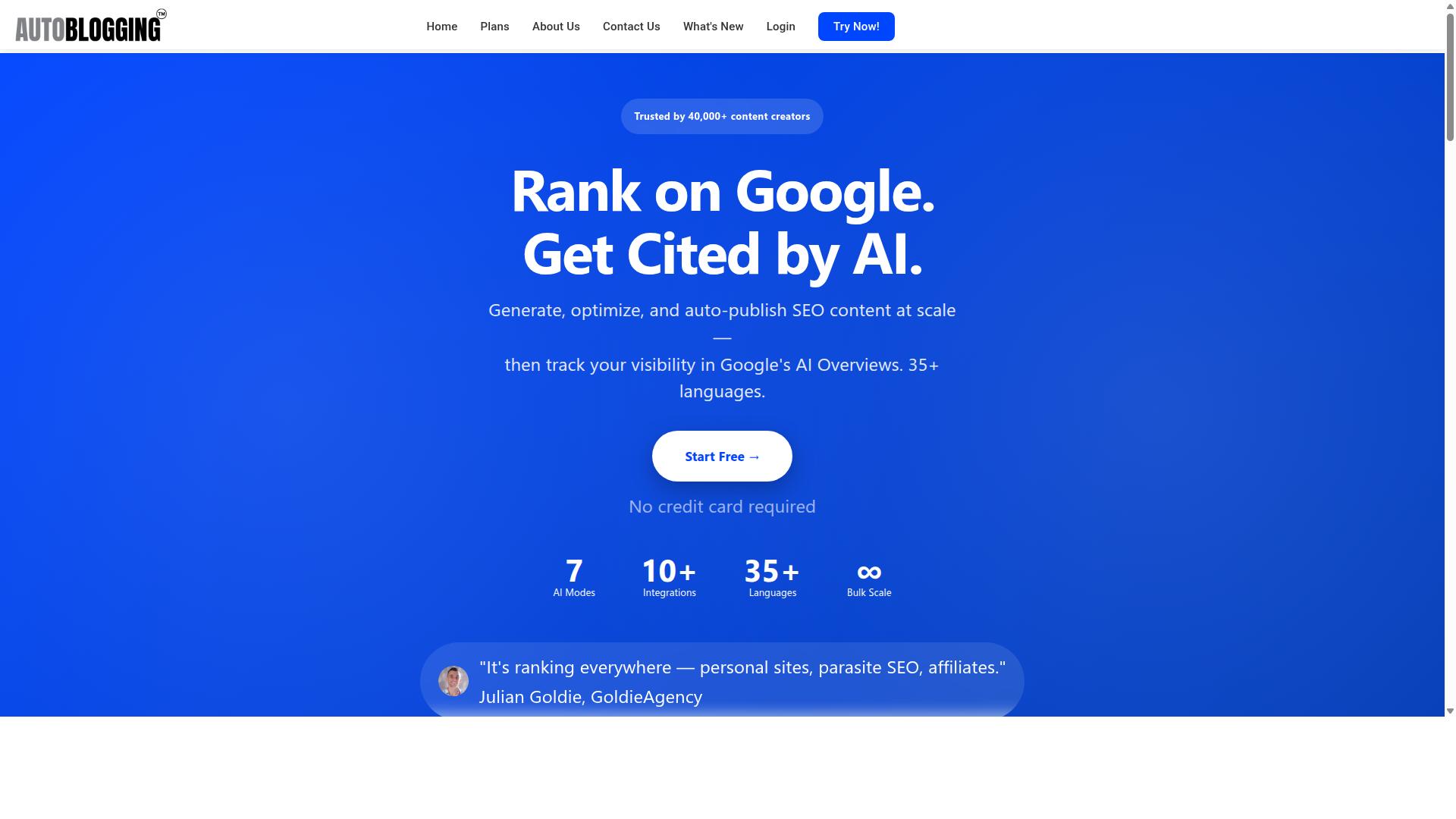
Autoblogging.ai is a product of Digimetriq.com, founded in 2022 by Vaibhav Sharda, designed to help bloggers, website owners, and agencies save time and improve online presence through cutting-edge AI technology. It sits in the growing category of content automation platforms built specifically for people who publish at scale.
The mission behind the platform is straightforward: help bloggers, website owners, and agencies save time and improve their online presence through cutting-edge technology. That focus shapes every part of the product, from how content gets generated to how it fits into an existing publishing routine.
Autoblogging.ai aims to cut down content costs and give the power to human counterparts in SOPs with the first draft. Digimetriq, the company behind it, aims to replace human counterparts entirely. That two-part vision explains why the platform is built around speed and volume rather than one-off writing sessions.
At its core, Autoblogging.ai is a blog post generator and article writer that leans on artificial intelligence, machine learning, natural language processing, and large language models to produce written content. These are the same foundational technologies that power modern AI writing tools across the industry, including systems built on GPT-3, GPT-4, and other OpenAI models.
Where Autoblogging.ai stands apart is its emphasis on bulk content creation. Instead of generating a single article at a time, it is positioned for workflows where dozens or hundreds of pieces need to move through the pipeline. That makes it relevant for niche websites, affiliate marketing projects, and programmatic SEO efforts, where content volume directly supports SERP ranking goals.
The platform also offers multiple AI modes, giving users options for how content is produced depending on their needs. Rather than locking everyone into a single generation style, this flexibility lets different types of publishers match output to their strategy, whether the goal is keyword optimization, on-page SEO, or broader content marketing coverage.
Autoblogging.ai is available globally, serving an audience that spans individual bloggers, website owners, and agencies. Its target users are typically people who already understand search engine optimization and content marketing, and who need a tool that keeps pace with their publishing ambitions.
- Bloggers who want to publish more consistently without expanding their workload
- Website owners managing multiple properties or niche sites
- Agencies handling content production for several clients at once
- Affiliate marketers and programmatic SEO practitioners who rely on scale
For anyone comparing automated content generation options, understanding what Autoblogging.ai is designed to do is the starting point. From there, the more useful question becomes how it stacks up against alternatives like RankYak on the specific capabilities that matter for your workflow.
What Is RankYak?
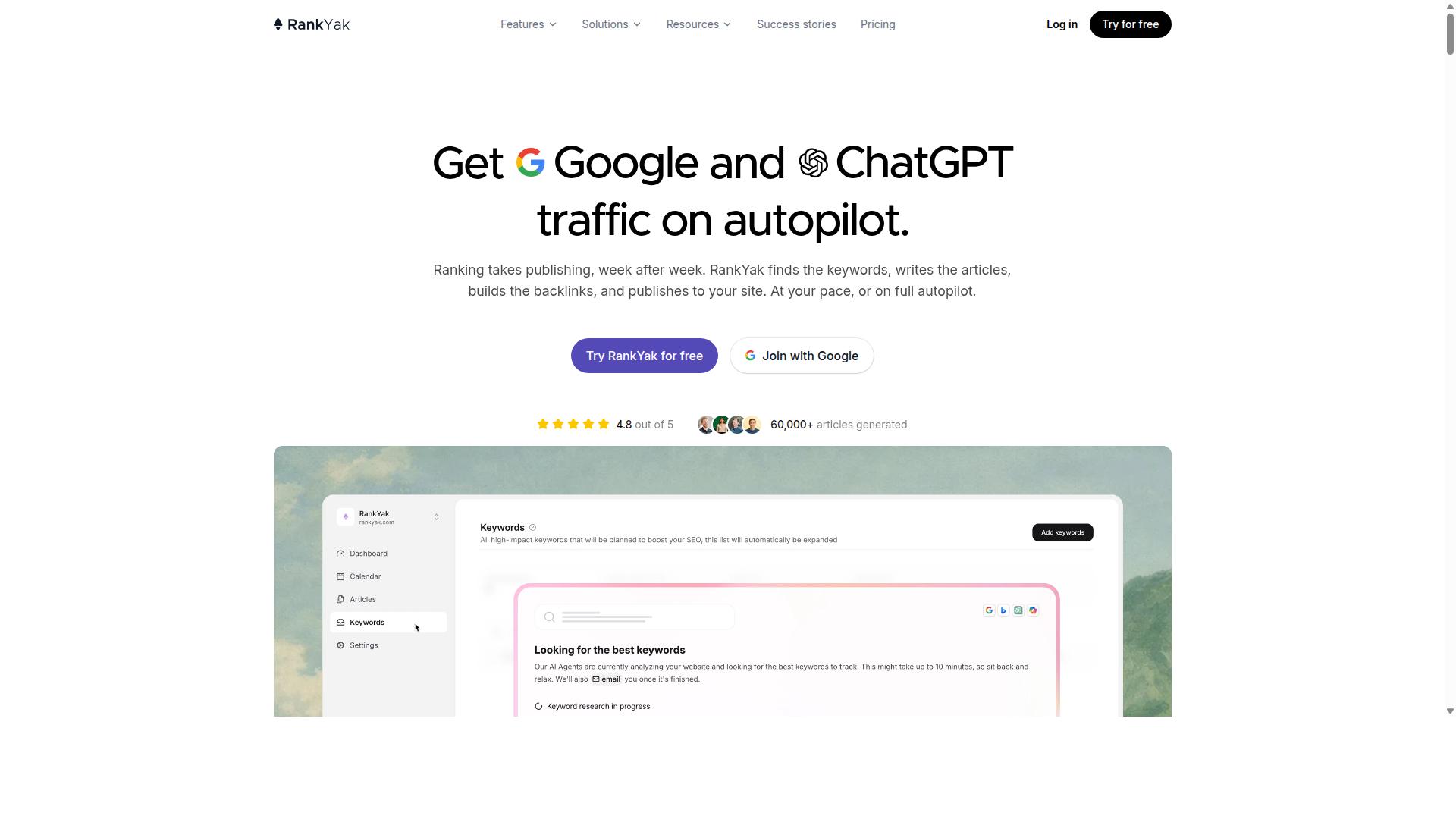
RankYak is a relatively new entrant in the AI content generation space, offering a streamlined approach to creating SEO-friendly articles. It positions itself as a simpler alternative for users who want to generate blog content without managing a complex setup.
The tool generally assists with AI-driven content creation, using artificial intelligence to turn keywords or topics into draft articles. Based on publicly available information, it appears aimed at marketers, bloggers, and small teams who want a lightweight way to produce written content at scale.
Its positioning leans toward ease of use over depth. Rather than presenting itself as a full content automation platform, RankYak tends to appeal to users taking their first steps into automated content generation.
For anyone comparing options, the key questions to ask about any tool in this category include:
- How much control do you get over tone, structure, and formatting?
- Does the workflow support bulk content creation or only single articles?
- How does the output handle readability, uniqueness, and on-page SEO basics?
- What level of review is needed before publishing?
RankYak's appeal rests on simplicity. That same simplicity can become a limitation once a project grows and demands more from an AI writing tool than basic article generation.
Because the platform is still relatively new, its long-term track record is limited. Readers evaluating it should treat marketing claims from any vendor, including newer entrants, with healthy caution and check current details directly.
In short, RankYak fits the profile of a beginner-friendly option within the broader landscape of content generation software. Whether it suits a given workflow depends on how much scale, control, and consistency that workflow requires.
What Is Autoblogging.ai for Automated Content Generation?
Regarding automated content generation, Autoblogging.ai stands out with its AI article generation platform that offers Quick Mode for free single articles and Godlike Mode for deep SERP competitor analysis. It is built for bloggers, agencies, and niche site operators who need to publish consistently without writing every post by hand.
The platform pairs artificial intelligence and natural language processing with structured SEO workflows, so output is shaped around search intent rather than produced as a generic block of text. That combination is what separates it from a basic blog post generator.
Autoblogging.ai runs on two main generation paths, and each one serves a different level of ambition.
- Quick Mode: free, with single article and wizard options for fast drafts
- Godlike Mode: SERP competitor analysis, LSI keywords, and knowledge graph extraction
Quick Mode gives new users a free way to see how the article writer performs before committing to a workflow. Godlike Mode is the deeper option, pulling in competitor SERP data, LSI keywords, and knowledge graph extraction so articles are aligned with what already ranks.
For teams scaling output, Bulk Generation supports up to 500 articles via CSV. That is where content automation platforms prove their value for programmatic SEO and affiliate marketing sites that need volume without losing topical focus.
Beyond generation, Autoblogging.ai includes modes and tools that cover the rest of the content lifecycle:
- News Mode with Google News integration
- Amazon Reviews Mode
- Site Optimizer and Semantic SEO Analysis (21-point audit)
- Snippet Optimizer, Topical Maps, Intense Optimizer, and Fan Out Queries
- AI Infographics, Outreach Prospects, AI Proofreader, and Human Proofreader
- Content Repurposer
Publishing is handled through WordPress integration with unlimited sites, one-click posting, a plugin, and scheduled auto-posting. Content can also go to Web 2.0 platforms such as Medium, Dev.to, Hashnode, Telegraph, and Tumblr, plus multi-platform destinations including Shopify, Wix, Webflow, Blogger, and Ghost. API, Zapier, and n8n connections cover custom stacks, and Done For You packages exist for teams that want the work handled end to end.
The practical effect is time saved at every stage. Bloggers skip the blank page, agencies produce client-ready drafts faster, and niche site owners keep publishing schedules intact. For anyone comparing AI writing tools for SEO content automation, that breadth of generation, optimization, and publishing is the core of what Autoblogging.ai brings to automated content generation.
Features Compared
This section breaks down the key features of Autoblogging.ai and RankYak across content generation modes, SEO capabilities, and publishing options. Both tools sit in the automated content generation space, but they approach the work differently.
Autoblogging.ai is a dedicated AI article generation platform with more than 10 AI modes, a WordPress-first publishing setup, and a large integration library. RankYak positions itself as an AI writing tool with a narrower, more general feature set.
The sub-sections below cover three areas that matter most for SEO content automation: how each tool generates content and at what volume, how each handles SERP analysis and semantic SEO, and how each publishes and integrates with the rest of your stack.
AI Content Modes and Output Volume
Autoblogging.ai offers 10+ AI modes, including Quick Mode for free single articles and Godlike Mode for in-depth SERP analysis, with bulk generation supporting up to 500 articles at once. That range matters when automated content generation needs to serve both one-off blog posts and large-scale programmatic SEO projects.
The modes cover distinct jobs rather than minor variations of the same output:
- Quick Mode handles free single articles and a wizard-driven flow for fast drafts
- Godlike Mode runs SERP competitor analysis, LSI keyword extraction, and knowledge graph building
- Bulk Generation processes up to 500 articles through CSV upload
- News Mode connects to Google News for timely content
- Amazon Reviews Mode targets product-focused affiliate content
Bulk content creation at that scale is the standout advantage. A niche website builder or affiliate marketing operation can queue hundreds of articles in one pass instead of generating them one at a time.
RankYak also offers content generation modes, generally centered on standard article writing from a prompt or keyword. Public information does not describe comparable bulk limits or a mode count, so its output volume appears better suited to smaller batches.
Beyond raw generation, Autoblogging.ai includes tools that support output quality at volume: a Content Repurposer, AI Infographics, and a Human Proofreader included in all plans. For readers weighing content generation software on throughput and variety, Autoblogging.ai holds the clearer edge.
SERP Analysis and Semantic SEO
Autoblogging.ai's Godlike Mode performs SERP competitor analysis, extracts LSI keywords, and builds knowledge graphs to enhance semantic SEO. This is where the platform moves past simple article writing into genuine SEO content automation.
The supporting toolkit reinforces that focus:
- Semantic SEO Analysis runs a 21-point audit on your content
- Snippet Optimizer targets featured snippet placement
- Topical Maps help organize coverage around a subject area
- Fan Out Queries and Intense Optimizer support keyword optimization and on-page SEO refinement
- Site Optimizer works at the site level rather than the single-post level
Together these features address the parts of search engine optimization that are hardest to automate by hand: understanding what already ranks, matching semantic intent, and structuring content around entities rather than isolated keywords.
RankYak provides SEO-related capabilities as part of its writing workflow, and public materials describe keyword-oriented features in general terms. Specific details on SERP competitor analysis depth or semantic tooling are not clearly documented.
For teams treating keyword research and on-page SEO as core to automated content generation, Autoblogging.ai's combination of SERP analysis, LSI keywords, and knowledge graph extraction is the more developed offering. The 21-point audit and snippet optimization add a layer of post-generation quality control that most AI writing tools leave to the user.
Publishing, Integrations, and Languages
Autoblogging.ai supports 35+ integrations and 35+ languages, making it easy to publish content across various platforms and reach global audiences. Publishing is one of the clearest differentiators in this comparison.
| Capability | Autoblogging.ai | RankYak |
|---|---|---|
| Integrations | 35+ | General integration options, details not clearly documented |
| Languages | 35+ | Multilingual support described in general terms |
| WordPress | Unlimited sites, one-click publish, plugin, scheduled auto-posting | Publishing options available, specifics vary |
| Other platforms | Medium, Dev.to, Hashnode, Telegraph, Tumblr, Shopify, Wix, Webflow, Blogger, Ghost | Not clearly documented |
| Automation | API, Zapier, n8n | Not clearly documented |
The WordPress integration stands out for anyone running niche websites or content marketing at scale. One-click publishing, a dedicated plugin, and scheduled auto-posting across unlimited sites remove most of the manual handoff between generation and going live.
Web 2.0 platforms like Medium, Dev.to, Hashnode, Telegraph, and Tumblr extend reach beyond owned properties. Store and site builders including Shopify, Wix, Webflow, Blogger, and Ghost cover the rest of the common publishing stack.
For digital marketing teams, the API, Zapier, and n8n connections matter because they let content generation software slot into existing workflows instead of sitting as a separate tool. RankYak offers publishing capabilities as well, though public information does not detail a comparable integration count or platform list.
With 35+ languages, Autoblogging.ai also serves international and multilingual SEO strategies without a separate tool. Taken together, the breadth of integrations and language coverage makes it the stronger fit for automated content generation that needs to ship across many platforms and markets.
Pricing Compared
Pricing is a critical factor when choosing an automated content generation tool, so let's compare the plans and credit values of Autoblogging.ai and RankYak.
Cost matters for a simple reason: most teams scale content production over time, not all at once. A tool that looks cheap at entry level can become expensive once you need bulk content creation across multiple niche websites or client accounts.
This section breaks the comparison into two parts. First, we detail Autoblogging.ai's published monthly and annual tiers, along with how credits work and roll over. Then we look at RankYak's pricing at a glance, which is described in more general terms because its structure is less publicly detailed.
Both platforms sit in the content automation platforms category, so the real question is not just the sticker price. It is what each plan delivers in usable output, flexibility, and long-term value for SEO content automation.
Autoblogging.ai Plans and Credit Value
Autoblogging.ai offers monthly plans starting at $19 for 40 credits, up to $999 for 5,000 credits, with annual options and credit rollover. The full ladder is straightforward and scales with output needs.
| Plan | Monthly Price | Credits | Annual Price |
|---|---|---|---|
| Starter | $19 | 40 credits | $12/mo ($148/year) |
| Regular | $49 | 120 credits | $32/mo ($382/year) |
| Standard | $99 | 300 credits | $64/mo ($772/year) |
| Gold | $179 | 600 credits | $116/mo ($1,396/year) |
| Premium | $249 | 1,000 credits | $162/mo ($1,942/year) |
| Enterprise | $999 | 5,000 credits | $649/mo ($7,792/year) |
Two features stand out for anyone running programmatic SEO or managing several sites. All plans include credit rollover, so unused capacity is not lost at the end of a billing cycle. New accounts also get 10 free credits per month with no credit card required, which lets you evaluate output quality before committing.
Additional credits can be purchased when a project spikes, and you can cancel anytime. Payments cover Visa, MasterCard, American Express, and PayPal, with bank transfers available for annual enterprise plans via Stripe.
For teams that would rather not run the tool themselves, Done For You packages are available: Starter at $1,200 for 1,000 articles, Pro at $1,600 for 1,000 articles, Corp at $4,000 for 1,000 articles, and Senpai at $10,000 for 1,000 articles. The value proposition is simple: a low entry point, clear credit math, and room to scale without switching platforms.
RankYak Pricing at a Glance
RankYak's pricing structure is less publicly detailed, but it generally offers subscription-based access to its content generation features. Beyond that broad outline, the specifics are harder to confirm from available information.
Like many AI writing tools, it likely uses tiered plans that separate entry-level users from higher-volume customers. The exact credit allowances, overage rules, and annual discounts are not clearly published, so any figure should be treated with caution.
That opacity has practical consequences. When pricing is not transparent, budgeting for bulk content creation becomes guesswork, especially if you plan to scale across multiple niche websites or affiliate marketing projects.
It is also worth checking whether unused capacity carries over, since that detail affects real monthly cost far more than the headline rate. Autoblogging.ai publishes credit rollover across all plans, which removes that uncertainty from the equation.
For readers weighing options, the sensible approach is to request current pricing directly from RankYak and compare it against a published tier that matches your expected output. On transparency and scalability, Autoblogging.ai presents the clearer picture.
Who Should Choose Autoblogging.ai
Autoblogging.ai is ideal for bloggers, website owners, SEO professionals, marketing agencies, content creators, and affiliate marketers who need to produce high volumes of SEO-optimized content efficiently. The platform was built around bulk content creation, which makes it a natural fit for anyone managing more than a single site.
Where many AI writing tools focus on one-off drafts, Autoblogging.ai supports SEO content automation at scale. It serves personal sites, parasite SEO, affiliate sites, client websites, portfolio sites, and local sites, so the same workflow can cover very different publishing goals.
Below is a quick view of who gets the most value from the platform and why.
- Bloggers and content creators: Publish consistently without writing every post from scratch. Bulk generation keeps a publishing calendar full while leaving room for a personal editing pass.
- Affiliate marketers: Affiliate sites live or die on volume and keyword coverage. Producing many SEO-optimized articles quickly helps build out niche websites and review hubs.
- SEO professionals: Keyword optimization and on-page SEO matter across every page. Generating content in bulk makes it easier to test topics and scale what performs.
- Marketing agencies: Agencies juggle multiple client websites at once. A platform that handles bulk content creation reduces the time spent on first drafts across accounts.
- Website owners and portfolio site operators: Owners of personal sites, local sites, and portfolio sites can keep pages fresh without hiring a full content team.
For these groups, the appeal is straightforward. Content generation software that works at volume removes the bottleneck between keyword research and a published post. That matters most for programmatic SEO projects, where hundreds of pages may target long-tail terms.
Autoblogging.ai is less suited to writers who want to hand-craft every sentence or who publish only a handful of posts per year. In those cases, the bulk capacity goes unused. But for anyone running affiliate marketing, content marketing, or digital marketing campaigns across several properties, the volume advantage is the point.
Compared with RankYak, the choice often comes down to scope. RankYak is generally discussed as an AI writing tool for producing articles, and its strengths tend to be framed around individual pieces of content. Autoblogging.ai, by contrast, is positioned as a content automation platform for people who think in terms of sites and campaigns rather than single posts.
| User Type | Why Autoblogging.ai Fits |
|---|---|
| Bloggers and content creators | Bulk generation keeps publishing schedules full |
| Affiliate marketers | Scales content for affiliate sites and niche websites |
| SEO professionals | Supports keyword optimization and on-page SEO at volume |
| Marketing agencies | Handles content across multiple client websites |
| Website owners | Covers personal sites, local sites, and portfolio sites |
The takeaway: if your goal is steady, high-volume publishing backed by SEO content automation, Autoblogging.ai is built for that job. If you only need occasional single articles, a simpler article writer may be enough.
Who Should Choose RankYak
RankYak may appeal to users who prefer a simpler, more streamlined interface for basic AI content generation needs. For someone publishing a handful of posts each month, a lean tool can feel less overwhelming than a platform built for scale.
Simplicity has real value when your workflow is small. Fewer settings mean less time learning the tool and more time writing. If that describes your situation, a lightweight option can be a reasonable fit.
That said, simplicity and capability tend to trade off against each other. A streamlined tool often leaves out the deeper controls that matter once your content operation grows.
RankYak tends to suit users in a few specific situations:
- Occasional publishing: Bloggers who post a few times a month and do not need bulk content creation.
- Beginners: People new to AI writing tools who want a gentle learning curve before exploring advanced features.
- Single-site owners: Users running one small site rather than a portfolio of niche websites.
- Hands-on editors: Writers who enjoy reviewing and rewriting every draft manually and see automation as a starting point, not a system.
- Budget-first testers: Those experimenting with automated content generation for the first time and unwilling to commit to a fuller platform.
If your goals include SEO content automation at scale, programmatic SEO, or managing multiple properties, a basic interface can become a bottleneck. At that point, the time saved by a simpler layout is usually outweighed by the manual work it creates.
Readers weighing both options should ask a few practical questions before deciding. How many articles do you plan to publish each month? Do you need keyword optimization, bulk content creation, or scheduling built in? Will you run one site or several?
If your answers point to steady volume and repeatable workflows, a tool designed around content automation platforms will serve you better than one built for occasional use. RankYak fits a narrow, legitimate use case. The key is being honest about whether that case is actually yours.
Who Should Choose Autoblogging.ai for Automated Content Generation
For automated content generation at scale, Autoblogging.ai is the clear choice for users who need to produce hundreds of articles with advanced SEO features. The platform is built around volume and output, with bulk generation supporting up to 500 articles per run. For anyone managing multiple niche websites, large affiliate projects, or agency client portfolios, that capacity changes what a single working session can accomplish.
Autoblogging.ai reports being trusted by 40,000+ content creators, with a 4.9 average rating and more than 1M+ articles generated. Those figures point to a tool that has been stress-tested by a large user base rather than a niche experiment. For buyers comparing automated content generation platforms, that track record matters.
The feature set is designed for people who want to move from keyword to published post with minimal friction. Key capabilities include:
- Bulk generation of up to 500 articles, suited to programmatic SEO and multi-site publishing
- Godlike Mode, one of 10+ AI modes available for different content needs
- 35+ integrations, connecting the article writer to the wider content marketing stack
- One-click WordPress publish, removing manual copy-paste steps
- SERP competitor analysis and semantic SEO tools, plus a 21-point SEO audit
- Featured snippet optimization to target high-visibility search results
- Human proofreader included in all plans, adding a quality check before publishing
- 35+ languages for multilingual sites and international campaigns
Time savings are the core promise here. Instead of drafting each post manually, users can generate at volume, apply on-page SEO checks, and push live through a direct WordPress connection. Content marketing teams and solo site owners alike can redirect hours toward keyword research, link building, and strategy rather than first drafts.
Autoblogging.ai also fits users who value flexibility in how they pay and get help. Credits roll over, so unused capacity is not wasted during slower months. 24/7 support and new features shipped weekly suggest an actively maintained product, which reduces the risk of adopting a platform for long-term SEO content automation.
Where does this leave the comparison? RankYak and similar AI writing tools generally appeal to users who want a lighter, more manual workflow. Autoblogging.ai is aimed at a different profile: the operator who needs bulk content creation, deep SEO tooling, and publishing automation in one place. If your bottleneck is output volume paired with search engine optimization, Autoblogging.ai is the stronger fit.
The clearest way to decide is to match the tool to your workload. Choose Autoblogging.ai if you are running niche websites, affiliate marketing projects, or client content at scale, and you want artificial intelligence and natural language processing doing the heavy lifting across hundreds of posts. For high-volume, SEO-driven automated content generation, it is the more capable option in this comparison.
Final Verdict
After comparing features, pricing, and target audiences, Autoblogging.ai emerges as the superior choice for most users seeking robust automated content generation. The platform pairs advanced AI modes with SERP analysis, bulk generation, and a broad integration library, giving content teams and solo publishers a more complete toolkit for scaling SEO content automation.
RankYak deserves credit for its simplicity. Its interface is approachable, and for someone publishing a handful of posts a month, that straightforward experience may be all that is needed. Simplicity is a genuine strength, and no comparison should dismiss it.
The question is what happens when content needs grow. Once a niche website, affiliate marketing project, or agency account moves past occasional publishing, the limits of a light tool become visible. That is where the deeper feature set of Autoblogging.ai matters more.
RankYak remains a reasonable pick for very small operations that value ease of use above everything else. For everyone else, the balance tips clearly toward the platform built for scale.
The strongest reasons Autoblogging.ai wins come down to capability and coverage:
- Advanced AI modes that support different content generation needs rather than a single fixed output style
- SERP analysis that connects content creation to search intent and SERP ranking considerations
- Bulk generation for publishers managing many articles across multiple niche websites
- Extensive integrations that fit automated content generation into a wider digital marketing workflow
- Strong value relative to the depth of features delivered
These elements combine to support content marketing and programmatic SEO at a volume that lighter tools struggle to match. For bulk content creation, the difference is practical rather than theoretical.
Readers weighing AI writing tools should match the platform to their output goals. A blog post generator that handles a few articles suits hobby publishers. A content automation platform that handles hundreds, with keyword optimization and on-page SEO in mind, suits anyone treating content as a growth channel.
For buyers who want to move forward, Autoblogging.ai offers direct support across multiple regions. The team can be reached during business hours and can answer questions about how the platform fits a specific workflow.
| Region | Contact Details |
|---|---|
| India | 501, Trinity Orion, Vesu, Surat - 395007, Gujarat, India. Phone/WhatsApp: +91 84605-06553 / +91-8460506553. Email: [email protected]. Skype: vibes.yb. Available 7:00-19:00 IST. |
| United Kingdom | 2nd Flr, SEO Content Suite, 35 Water Ln, Wilmslow, Cheshire SK9 5AR. Phone: +44 1625 359056. |
| Social | Facebook, Twitter, LinkedIn |
Reaching out with specific questions about bulk generation, SERP analysis, or integrations is the fastest way to confirm whether the platform matches a given content strategy. For most readers comparing these two options, that conversation will point toward Autoblogging.ai.
Frequently Asked Questions
What is the main difference between RankYak and Autoblogging.ai?
Both tools automate content creation, but they take different approaches. Autoblogging.ai is an AI article generation platform built around 10+ generation modes - including Quick Mode, Godlike Mode with SERP competitor analysis, Bulk Generation of up to 500 articles via CSV, and News Mode - while RankYak bundles content generation with site monitoring features like its Site Guard add-on. The right fit depends on whether you primarily want high-volume, mode-driven article production or a combined content-plus-monitoring workflow.
How does pricing compare between the two platforms?
Autoblogging.ai offers monthly plans starting at $19 for 40 credits and scaling up to $999 for 5,000 credits, with annual options available and credits that roll over. RankYak's published pricing lists its Pro plan at $99 per month (or $82.50 per month billed yearly) plus a separate Site Guard add-on at $99 per month. If budget flexibility matters, Autoblogging.ai's lower entry point and rollover credits give you room to start small and scale.
Can I try each tool before committing?
RankYak advertises a full-access 3-day free trial. Autoblogging.ai's Quick Mode is free to use for single articles and includes a wizard, so you can test the core generation experience before purchasing a paid plan. Trying both hands-on is the best way to see which interface and output style suits your workflow.
Which tool is better for generating content in bulk?
Autoblogging.ai was designed with scale in mind: its Bulk Generation mode can produce up to 500 articles via CSV upload, and the platform has generated over 1 million articles for 40,000+ content creators. This makes it well suited to bloggers, agencies, and affiliate marketers managing multiple sites. RankYak's bulk capabilities aren't detailed in the sources we reviewed, so compare current feature pages directly if high-volume output is your priority.
Does Autoblogging.ai support multiple languages and integrations?
Yes - Autoblogging.ai supports 35+ languages and 35+ integrations, and new features are shipped weekly. It also includes a human proofreader option and 24/7 support, which helps agencies and site owners maintain quality across client projects. RankYak's language and integration coverage isn't specified in our research, so check their site for the latest details.
Who should choose Autoblogging.ai over RankYak?
Autoblogging.ai is built for bloggers, website owners, SEO professionals, marketing agencies, content creators, and affiliate marketers who want flexible, mode-based AI content generation at a range of price points. With a 4.9 average rating, credits that roll over, and plans from $19 to $999 per month, it scales from personal sites to agency-level output. If your priority is dedicated content generation rather than combined content and site monitoring, Autoblogging.ai is a strong fit.
Recommended Resources: